

A homeowner in San Antonio ignored her overflowing gutters for one rainy season. She assumed it was just minor clogging or debris buildup and figured a little water spillage was no big deal. By spring, she had a cracked foundation, a damp basement wall, and a repair bill that came in just under $9,000.
The cause? Her gutter downspouts were one size too small for her roof.
This guide will save you from that exact situation. If you are replacing old downspouts, installing a new gutter system, or just trying to understand why your gutters overflow every time it rains, you will find a clear and practical answer here. No engineering degree required.
By the time you finish reading, you will know exactly what size downspout your home needs and what warning signs to watch for if your current system is already undersized.
Why Downspout Size Is More Important Than Most Homeowners Realize
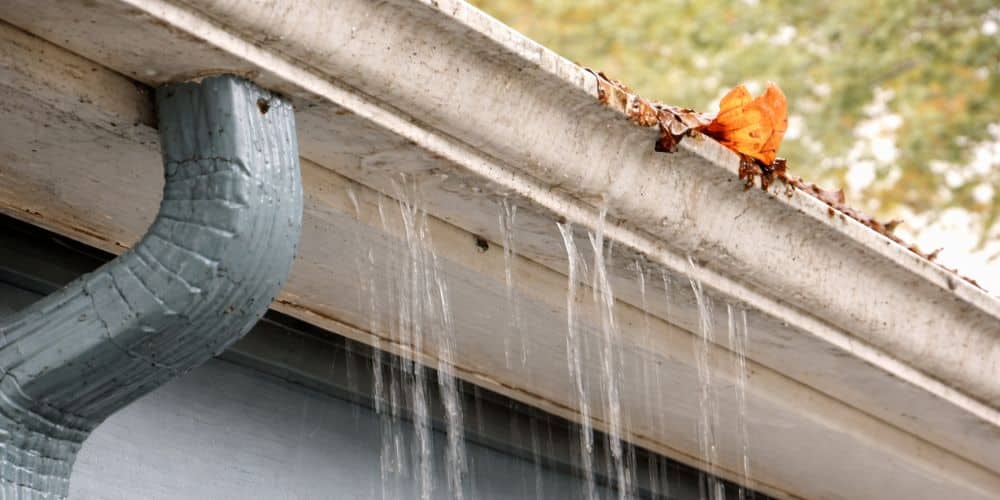
Your gutter system has one job: collect rainwater from your roof and move it safely away from your home. The downspout is the exit point. It is the pipe that carries all of that collected water from the gutter down to the ground.
When that pipe is too narrow, water has nowhere to go. It backs up. It overflows. It sits against your fascia, seeps behind your siding, and eventually finds its way toward your foundation.
Think of it like a kitchen drain. If the drain is too small for the water rushing in, the sink overflows no matter how clean it is.
In Texas, this matters even more. Houston receives over 50 inches of rain per year. Dallas sees intense spring storm seasons. Austin sits in one of the most flash-flood-prone regions in the entire country. San Antonio may not get the same annual totals as Houston, but it regularly sees sudden, heavy downpours that overwhelm undersized systems just as quickly. When a Texas thunderstorm hits, it does not ease in gently. It drops inches of water in minutes. Your downspout either handles that volume or it does not.
Getting the size right is not an upgrade. It is a baseline requirement.
Standard Downspout Sizes: What Is Available
Downspouts come in a few standard sizes. Most American homes use rectangular downspouts, though round styles exist for traditional and historic homes. Some homeowners also explore alternatives like chain downspouts, though for most Texas homes dealing with heavy rain, traditional pipe downspouts remain the more reliable choice.
| Size | Dimensions | Drainage Capacity | Best For |
|---|---|---|---|
| Small | 2″ x 3″ | Up to ~600 sq ft of roof | Small homes, porches, sheds |
| Standard | 3″ x 4″ | 600–1,200 sq ft of roof | Most US and Texas homes |
| Large | 4″ x 5″ | 1,200–2,000+ sq ft of roof | Large homes, heavy rain regions |
| Round 3″ | 3″ diameter | ~700 sq ft of roof | Traditional/half-round gutter homes |
| Round 4″ | 4″ diameter | ~1,100 sq ft of roof | Larger traditional-style homes |
One thing most homeowners do not know: the size name refers to the nominal (label) size, not the exact interior measurement. A “3×4” downspout has a slightly smaller actual opening. This is why it is important not to guess and why upsizing is almost always the smarter call in heavy rain regions like Texas.
The 4 Factors That Determine Your Right Downspout Size
There is no single universal answer. The right downspout size depends on four things specific to your home and location.
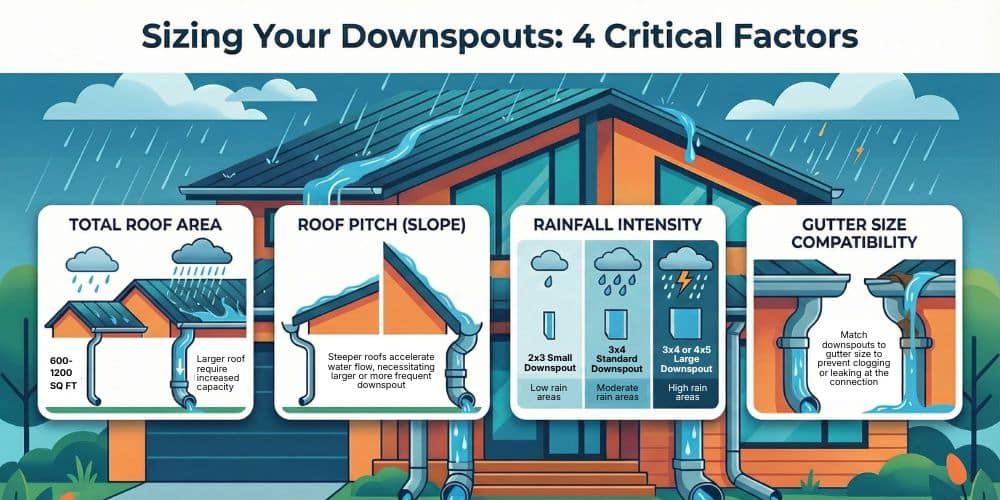
1. Roof Drainage Area
The bigger your roof, the more water it sheds during a rainstorm. To find your roof’s drainage area, measure the length and width of your home’s footprint and multiply them. For a 50 x 40 ft home, that is 2,000 sq ft of drainage area.
A general rule used by professional contractors: one properly-sized downspout can handle roughly 600–1,200 sq ft of roof area, depending on size. Larger roofs need either bigger downspouts or more of them, or both.
2. Roof Pitch (Slope)
A steeper roof collects the same amount of rain but funnels it faster. More velocity means more pressure on your downspouts at peak flow. The same way proper gutter slope determines how quickly water moves through the system. Contractors apply a pitch multiplier to adjust for this:
| Roof Pitch | Multiplier | What It Means in Practice |
|---|---|---|
| Flat to 3/12 | 1.0x | No adjustment needed |
| 4/12 to 5/12 | 1.05x | Slight increase in capacity needed |
| 6/12 to 8/12 | 1.1x | Size up or add a downspout |
| 9/12 to 11/12 | 1.2x | Significant increase needed |
| 12/12 (steep) | 1.3x | Always upsize – water rushes fast |
So if your roof is 1,800 sq ft with a 6/12 pitch, the adjusted drainage area is 1,800 x 1.1 = 1,980 sq ft. That is the number you size your downspouts against.
3. Rainfall Intensity in Your Area
This is the factor most homeowners overlook completely and the one that matters most in Texas.
Rainfall intensity is measured in inches per hour during a peak storm. The higher the intensity, the faster your downspouts must drain. You can check your local rainfall intensity data through NOAA’s Precipitation Frequency Data Server – a free, official tool that shows storm intensity by zip code across the entire United States.
Texas cities specifically:
| Texas Region | Cities | Rainfall Profile | Recommendation |
|---|---|---|---|
| Gulf Coast / East Texas | Houston, Beaumont, Galveston | Highest in TX — 50+ in/year, intense storms | 3×4 minimum; 4×5 for large roofs |
| Central Texas | Austin, San Antonio, Waco | Flash flood capital — short but extreme bursts | 3×4, maximize the number of downspouts |
| North Texas | Dallas, Fort Worth, Tyler | Heavy spring storms, 37 in/year average | 3×4 standard across the board |
| West Texas | El Paso, Midland, Lubbock | Low annual rain but sudden intense bursts | 2×3 possible; 3×4 is the safer choice |
For a more precise technical calculation, the SMACNA Drainage Calculator is the industry-standard tool used by professional contractors to size gutters and downspouts based on exact roof area and local rainfall data.
4. Gutter Size Compatibility
Your downspout must match the gutter it connects to. Using a downspout that is too wide for the gutter outlet causes leaks. Too narrow and it creates a bottleneck.
| Gutter Size | Correct Downspout Match |
|---|---|
| 4″ K-style gutter | 2×3 downspout |
| 5″ K-style gutter | 2×3 or 3×4 downspout |
| 6″ K-style gutter | 3×4 downspout |
| 5″ Half-round gutter | 3″ round downspout |
| 6″ Half-round gutter | 4″ round downspout |
If you are upgrading your downspouts, check your existing gutter size first. Mismatched sizing is one of the most common and most preventable installation mistakes.
Read this blog to avoid common mistakes when installing rain gutters.
2×3 vs 3×4 Downspout: The Texas Answer
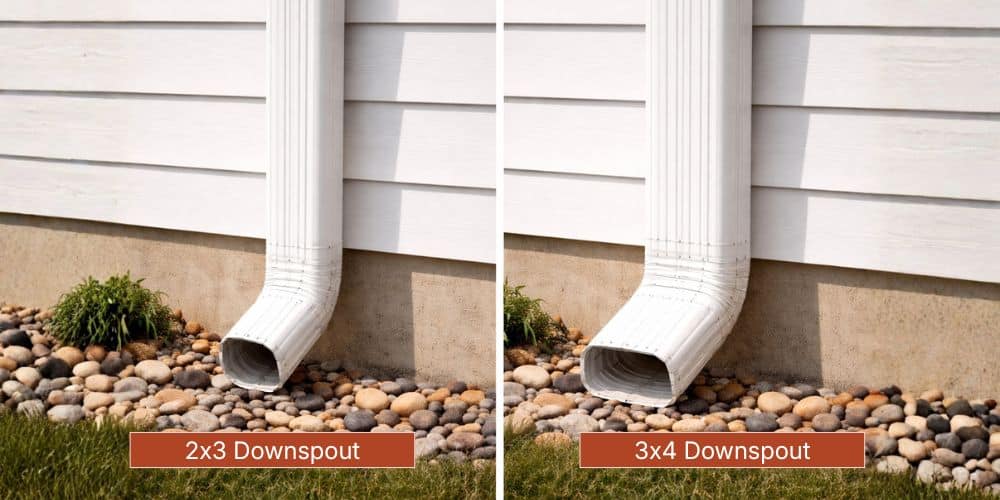
Here it is straight.
For the vast majority of Texas homes, choose 3×4.
A 2×3 downspout drains roughly 600 sq ft of roof area. The average Texas home sits between 1,500 and 2,500 sq ft. Add in Texas storm intensity, and a 2×3 is simply undersized for most situations.
A 3×4 downspout handles the volume. It handles the velocity. And it gives you a margin of safety when a storm drops two inches of rain in thirty minutes, which in Houston, Austin, and Dallas, happens every single spring.
The only time 2×3 makes sense in Texas:
- A small covered porch or shed
- A detached garage under 600 sq ft
- A short gutter run under 20 feet with minimal roof drainage
When in doubt, go 3×4. The cost difference is minimal. The protection difference is not.
How Many Downspouts Do You Need?
Size is only half the equation. Placement and quantity matter just as much.
The professional standard: one downspout for every 40 linear feet of gutter. So a home with 120 feet of guttering needs a minimum of three downspouts.
For Texas homes, especially in Houston, Austin, and Dallas, consider tightening that to one per 30 feet. More outlets mean less pressure on each individual downspout during a heavy storm. Corner placement is ideal. Avoid long stretches of gutter with no outlet; water will find the weak point.
Once your downspouts are properly placed, also consider where that water exits at ground level. Knowing when to add extensions to your downspouts can be just as important as sizing, especially on sloped lots or homes close to the foundation line.
Warning Signs Your Downspout Is the Wrong Size
Sometimes the problem is already there. You just have not connected the dots yet.
Walk around your home during or right after a rainstorm and look for these signs:
- Gutters overflowing at the front lip during rain, even when there is no visible blockage
- Pooling water directly against your foundation after storms
- Streaks or dark staining on siding below the gutter line
- Gutters pulling away or sagging from the fascia board
- Erosion channels in flower beds or soil beneath gutters
- Damp smell or moisture in your basement or crawlspace
- A loud rushing or gurgling sound from the downspout during rain
- Water marks on your driveway or walkway far from the downspout exit
Any one of these is a warning. Two or more means your system is already under stress. In Texas, where storms can go from light drizzle to flash flood in under an hour, an undersized system does not get a second chance.
Also Read: How to Clean a Gutter Downspout?
Frequently Asked Questions
What is the right downspout size for a 6-inch gutter?
The correct 6-inch gutter downspout size is 3×4 inches. A 6-inch K-style gutter carries a significantly higher volume of water than a standard 5-inch gutter, so pairing it with anything smaller creates a bottleneck and leads to overflow — especially during heavy Texas storms.
What downspout size for a 5-inch gutter is recommended?
For a 5-inch gutter, you can use either a 2×3 or a 3×4 downspout. However, for Texas homes, 3×4 is the stronger choice. A 2×3 may handle light rain but will struggle during intense storms common in Houston, Austin, and Dallas. Going with 3×4 gives you the extra capacity when it matters most.
Is 2×3 or 3×4 downspout better for Texas homes?
For Texas homes, 3×4 is almost always the better choice. The intensity of Texas storms, especially in Houston, Dallas, and Austin, exceeds what a 2×3 downspout can reliably handle on a standard-sized home. A 3×4 downspout drains up to twice the volume and provides a critical safety margin during heavy downpours.
How do I know if my downspout is too small?
The clearest sign is water overflowing the front of your gutters during rain, even when the gutters are clean. Other signs include pooling near your foundation, siding stains below the gutter line, and soil erosion beneath the gutters. If you notice any of these after a storm, your downspout size should be evaluated.
How many downspouts do I need per gutter run?
The standard rule is one downspout for every 40 linear feet of gutter. In Texas, where storm intensity is high, one per 30 feet is a smarter approach. Homes with large or steep roofs may need additional downspouts regardless of gutter length.
The Right Size Protects Everything Behind It
Choosing the right gutter downspout size is not a technical mystery. It comes down to four things: your roof size, your roof pitch, how hard it rains where you live, and whether your gutter and downspout are matched correctly.
For Texas homeowners, whether you are in Houston, dealing with tropical storms, in Austin watching the Barton Creek watershed rise, or in Dallas bracing for spring hail season, the answer is almost always the same. Go with 3×4. Space them properly. Make sure they match your gutters.
That small decision protects your foundation, your siding, your crawlspace, and your landscaping every single time it rains.
If you are not sure what your home currently has or whether it is working the way it should, the American Hill Country Gutter team is here to help. We serve homeowners across the Texas hill region with professional gutter inspections, sizing assessments, and full installation services. Contact us today for a free estimate and let us make sure your home is ready for whatever Texas weather brings next.
