
Blocked downspouts are one of the most common causes of overflowing gutters. When debris builds up inside the vertical pipe, rainwater cannot drain properly and begins backing up into the gutter system.
If the clog is not removed, trapped water can overflow behind the gutter, damage fascia boards, and pool near your home’s foundation.
This downspout cleaning guide shows you how to spot the signs, diagnose exactly where the blockage is, and clear it using five proven methods, including from the ground without a ladder. For the full system overview, see how to clean gutters like a pro.
Quick Answer: How to Clean Gutter Downspouts
If you need a fast solution, follow these steps:
- Remove debris around the downspout opening in the gutter.
- Insert a garden hose into the downspout and flush water through the pipe.
- Use a plumber’s snake if the clog does not break loose.
- Clear the bottom elbow from the ground if debris is visible.
- Run water through the system again to confirm proper drainage.
Most downspout clogs can be cleared in less than 15 minutes using these methods.
What Is a Clogged Downspout?
A clogged downspout is a vertical drainage pipe attached to your gutters that has become blocked by leaves, dirt, seed pods, shingle grit, or compacted debris. Instead of carrying rainwater away from your home’s foundation, water backs up inside the pipe and has nowhere to go.
Most clogs form at three locations:
- The top opening, where the gutter meets the downspout, the most common entry point for leaves and twigs.
- The elbow joint at the bottom of the pipe, where the downspout curves away from the wall, a natural trap for debris that gets washed down.
- The underground section of your downspout, if it connects to a buried drain, root intrusion and soil compaction can create blockages that are invisible from above.
Knowing where the clog is before you start saves 30 minutes of guesswork. The next section shows you how to find it.
Signs Your Downspouts Are Clogged
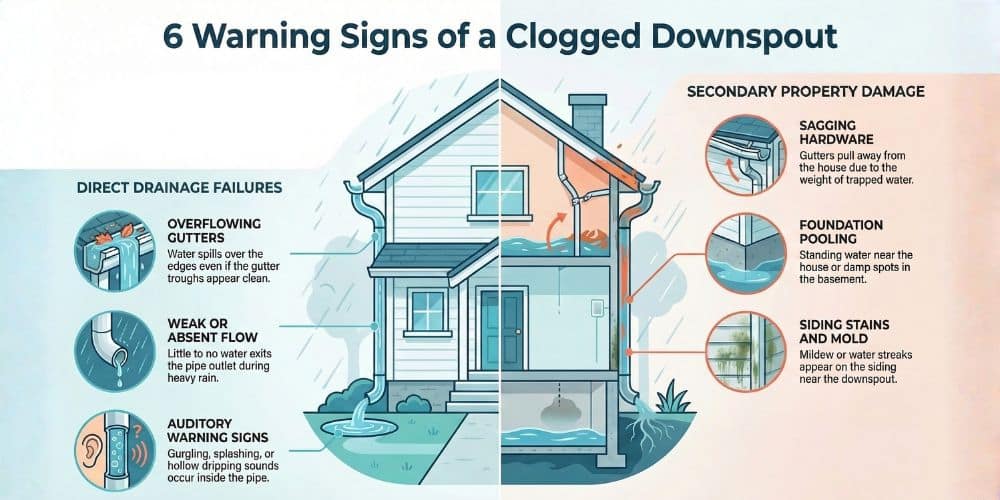
Watch for these common warning signs before or during rainfall. If you notice more than one of these issues, your downspout is likely blocked.
- Overflowing Gutters During Rain
Water spills over the edges of the gutter even though the gutter trough appears clean. - No Water Exiting the Downspout
During or after rainfall, little or no water comes out of the downspout outlet at ground level. - Slow or Weak Water Flow
Instead of a steady stream, water trickles out slowly, which often indicates a partial clog. - Gurgling or Dripping Sounds
Unusual sounds like gurgling, hollow dripping, or splashing inside the pipe after rain can signal trapped debris. - Sagging Gutters
Gutters begin to sag or pull away from the fascia board because trapped water adds extra weight. - Stains or Mold on Siding
Water stains, mildew, or mold streaks appear on the siding directly beside or below the downspout. - Unusually Lush Grass Below the Outlet
Plants or grass near the downspout outlet grow faster than the surrounding areas due to hidden leaks. - Water Pooling Near the Foundation
Standing water near your home’s foundation or damp spots in the basement after storms can indicate a clogged downspout.
If you see two or more of these signs, your downspout is blocked. Do not wait. Check our seasonal guide on when to clean gutters in Texas to understand how Texas weather patterns create more frequent clogs than most homeowners expect.
How to Find Where a Downspout Is Clogged
Do not start pulling apart your downspout before you know where the blockage is. Run these three quick tests first:
The Hose Flow Test
Insert a garden hose into the top of the downspout and run water at full pressure.
Observe the results:
- Water flows freely from the bottom: the downspout is clear.
- Water backs up at the top: the clog is in the upper pipe.
- Water exits but pools near the home: the underground drain line may be blocked.
The Tap Test
Tap along the outside of the downspout using your knuckles.
A hollow sound usually means the pipe is clear. A dull or heavy sound often indicates compacted debris inside.
The Visual Elbow Check
The bottom elbow is the most common clog point on the entire gutter system. Shine a flashlight into the elbow from the ground outlet. If you can see packed leaves or mud, the clog is right there, and you can clear it without climbing the ladder at all.
How to Clean Gutter Downspouts (5 Proven Methods)

Start with Method 1. Only move to the next method if the previous one does not fully clear the clog.
Method 1: Garden Hose Flush (Works for 60% of Clogs)
Best for: light to moderate clogs caused by loose leaves and light debris.
- Position your ladder safely beside the downspout, not leaning against it.
- Insert the hose nozzle into the top of the downspout as far as it will go.
- Turn the water on full pressure and hold it there for 30 seconds.
- Watch the bottom outlet. If water flows out clean within 10 to 15 seconds, the clog has cleared.
- Run the hose for another full 60 seconds to flush any remaining debris out completely.
Pro tip from the field: If you have a high-pressure nozzle, angle it slightly downward and work it in a circular motion as you push it into the pipe. This breaks the clog apart instead of just pushing it further down.
Method 2: Plumber’s Snake (Works for 90% of Compacted Clogs)
Best for: stubborn compacted clogs that the hose alone cannot shift.
- Feed the snake into the top opening of the downspout.
- Rotate the handle clockwise as you push it down. This pulls debris onto the snake coil rather than compressing it further.
- When you feel resistance, work the snake back and forth 8 to 10 times before withdrawing.
- Pull the snake out slowly and remove any debris from the coil.
- Flush with the garden hose to confirm the clog is gone.
- Repeat from the bottom elbow outlet if the clog persists.
Method 3: How to Clean a Clogged Downspout from the Ground (No Ladder Needed)
This method is ideal for two-story homes, homeowners who are uncomfortable on ladders, and elbow clogs at the bottom of the pipe.
- Locate the bottom outlet elbow at ground level where the downspout curves away from the wall.
- Shine a flashlight inside. If you can see the blockage, use gloved fingers or needle-nose pliers to pull it out directly.
- If the clog is further up, feed a drain auger upward through the bottom outlet and rotate it to break apart the blockage.
- Attach a wet-dry vacuum hose to the bottom outlet and turn it on full suction. This pulls loose debris down and out without any climbing.
- Finish by inserting your garden hose into the bottom outlet and running full pressure upward for 20 to 30 seconds. The backflush loosens any remaining packed material.
For a full breakdown of ground-level techniques, see our dedicated guide on how to clean gutters from the ground.
Method 4: Pressure Washer with Downspout Cleaning Kit
Best for: serious recurring clogs, two-story homes, or homeowners who want the fastest and most thorough result.
- Attach a flexible gutter cleaning wand or downspout cleaning kit to your pressure washer. These are available at most hardware stores for under $30.
- Feed the wand into the bottom outlet of the downspout.
- Turn the pressure washer on, starting at a low PSI setting (800 to 1,200 PSI for aluminum downspouts, up to 2,000 PSI for steel).
- Push the wand upward while the water runs to blast debris loose.
- Work the wand up and down several times, then withdraw and flush from the top with a regular hose to push loosened material out the bottom.
Not sure which tools to buy? We break down the best options in our post on the top 5 best tools for cleaning your gutters.
Method 5: Disassemble the Downspout Section
Best for: clogs that do not clear with any other method, or when you can pinpoint the exact blocked section using the tap test.
- Use a screwdriver or drill to remove the screws or pop the rivets holding the blocked section to the wall brackets.
- Carefully separate the clogged section from the rest of the downspout.
- Take the section to the ground and flush it forcefully with a hose from both ends.
- Use a broom handle or dowel rod to push any remaining debris through manually.
- Inspect the section for cracks, holes, or rust while it is off the wall.
- Reassemble securely and seal any loose joints with gutter sealant before reattaching to the brackets.
Clogged Downspout Methods Compared
Use this table to choose the right method for your specific situation:
| Method | Best For | Ladder Needed? | Difficulty |
|---|---|---|---|
| Garden Hose Flush | Light debris clogs | Yes (top access) | Easy |
| Plumber’s Snake | Compacted debris | Yes (top access) | Moderate |
| Ground Level Methods | Bottom elbow clogs | No | Easy |
| Pressure Washer | Severe or recurring clogs | Optional | Moderate |
| Disassemble Section | Any location, confirmed blockage | Yes | Advanced |
What Causes Downspouts to Clog? (Texas-Specific)
In the San Antonio and Hill Country area, downspout clogs have specific causes that homeowners in other parts of the country do not deal with as often:
- Live oak leaf debris: Live oaks shed small, waxy leaves year-round rather than seasonally. These compact tightly inside downspouts and are far harder to flush out than standard autumn leaves.
- Cedar pollen and elm seeds: Mountain cedar and cedar elm produce massive volumes of pollen and winged seeds from January through March. These form a paste-like sludge inside downspouts when wet.
- Shingle granule buildup: Aging asphalt shingles shed granules that wash into the gutter system and settle at elbow joints, forming a dense sludge that resists flushing.
- Pecan and mesquite debris: These trees drop heavy debris, including husks, stems, and bark fragments that are too large to pass through most standard downspout openings.
- Mud and silt from heavy storms: Intense Hill Country thunderstorms wash soil, silt, and sand directly off the roof and into the gutter system, where it compacts at bends and elbows.
Because of these local conditions, routine downspout cleaning three times per year is the right standard for this area, not the twice-a-year schedule most national guides recommend. Read our full guide on when to clean gutters in Texas for the exact schedule we recommend for Hill Country homeowners.
How to Stop Your Downspouts from Clogging Again
Clearing the clog is step one. Keeping it clear is where most homeowners fail. Here is what actually works:
Install a Downspout Strainer at the Top
A downspout strainer is a cage-shaped screen that sits at the opening where your gutter feeds into the downspout. It catches leaves and debris before they enter the pipe. This is the single cheapest and most effective preventive measure you can take. A good strainer costs under $10 and installs in two minutes.
Add Gutter Guards to the Full System
Gutter guards and leaf screens prevent the bulk of debris from entering the gutter trough in the first place, which drastically reduces what reaches your downspouts. For Texas homes surrounded by live oak or cedar, this is the highest-return investment you can make in your gutter system.
Flush After Every Major Storm
After any storm that drops more than an inch of rain or brings significant wind debris, take 60 seconds to run a garden hose through each downspout. Catching a partial clog before it becomes a full blockage takes one minute instead of an hour.
Check and Clear the Bottom Elbow Every Season
The bottom elbow is the number one clog location on every downspout. Make it part of your seasonal routine to shine a flashlight into it and clear any visible buildup. You never need a ladder for this check.
Trim Trees That Overhang Your Roofline
Live oaks, pecans, and cedar elms within 10 feet of your roofline deposit the most debris into your gutters. Annual trimming of overhanging branches reduces your cleaning frequency by 40 to 60 percent.
Downspout Cleaning Schedule for Texas Homes
| Situation | Recommended Frequency | Best Months |
|---|---|---|
| Standard home, minimal tree cover | 2x per year | April and November |
| Live oak or cedar nearby | 3x per year | February, June, November |
| Multiple large trees overhead | 4x per year | Feb, May, Aug, Nov |
| After any major storm | As needed | Check within 24 hours |
When a Clogged Downspout Needs Professional Help
Some situations require professional repair or replacement.
Call a professional if:
- Water still does not drain after multiple cleaning attempts
- The downspout is pulling away from the wall
- The pipe appears bent or crushed
- Water is entering the home or the basement
- Your home is two stories or taller, and ladder access is unsafe
Conclusion
Cleaning gutter downspouts is an essential part of maintaining your home’s drainage system. By locating the blockage and using the correct cleaning method, most clogs can be cleared quickly and safely.
Regular maintenance and simple preventive steps can keep your downspouts flowing properly and protect your home from costly water damage.
If your gutters or downspouts are damaged, improperly installed, or frequently clog, the system may need professional repair or upgrades.
American Hill Country Gutters installs and repairs gutter systems designed to improve drainage and reduce debris buildup for homes throughout the San Antonio and Texas Hill Country area.
Frequently Asked Questions About Clogged Downspouts
What is downspout cleaning and how is it different from gutter cleaning?
Downspout cleaning refers specifically to clearing, flushing, and inspecting the vertical pipes that carry water from your gutters down to ground level. Gutter cleaning focuses on removing debris from the horizontal trough along your roofline. Both are part of the same system, but downspout cleaning requires different tools and techniques since you are working inside a sealed pipe rather than an open channel. Many homeowners clean their gutters and skip the downspouts entirely, which is why blocked downspouts are the most common cause of gutter overflow even in homes that get regular maintenance.
What is the fastest way to unclog a downspout?
The fastest method is the garden hose flush. Insert the hose into the top of the downspout, run it on full pressure for 30 to 60 seconds, and most light to moderate clogs will clear. If the hose alone does not work, combine it with a plumber’s snake from the top or a wet dry vacuum from the bottom for immediate results.
Can a clogged downspout damage my foundation?
Yes, and this is the most expensive consequence of ignoring a blocked downspout. When water cannot drain away from your home, it pools directly against the foundation. In Central Texas, where soil expands and contracts heavily with moisture changes, repeated water pooling accelerates foundation movement, cracking, and settling. Even one bad storm season with a blocked downspout can cause thousands of dollars of foundation damage.
Why does my downspout keep getting clogged in the same spot?
A recurring clog in the same location usually means one of three things: a structural irregularity like a dent or kink in the pipe that catches debris, an elbow joint with too sharp an angle for your debris type to pass through, or a spot where shingle granule sludge is building up faster than it drains. The fix is either replacing that section with a wider or smoother joint, or installing a downspout strainer to intercept debris before it reaches the problem spot.
How do I clean a downspout without getting on a ladder?
Use Method 3 above. The key tools are a drain auger fed upward through the bottom elbow, a wet dry vacuum attached to the bottom outlet, or a pressure washer with a flexible downspout wand. All three work from the ground and handle the most common clog location (the bottom elbow) more directly than top-down methods. Our guide to cleaning gutters from the ground covers all ladder-free options in full detail.
Should I clean gutters or downspouts first?
Always clear the gutter troughs first, then flush the downspouts. If you flush the downspouts with packed gutter debris still sitting above the opening, you push the clog source directly into the pipe. Clear the gutters, then run the hose through the downspouts to flush everything through cleanly. For the full process, read how to clean gutters like a pro.
What does a clogged downspout sound like?
A healthy downspout during rain makes a smooth, steady rushing sound as water moves freely through the pipe. A clogged or partially blocked downspout makes a hollow dripping sound, an irregular gurgling, or goes silent entirely. Silence during a rainstorm is the worst sign. It means water is backing up into the gutter instead of flowing down the pipe.
How much does it cost to unclog a downspout?
A DIY unclogging costs nothing if you already own a garden hose and basic tools, or $20 to $50 if you need to buy a downspout strainer or drain auger. Professional downspout cleaning typically costs $75 to $200 per downspout depending on height, access, and severity of the blockage. Annual professional gutter and downspout maintenance is almost always cheaper than a single foundation repair bill.