

Most homeowners think of gutters as a roof accessory, something that keeps water off the porch on a rainy day. But gutters actually play a much bigger role they’re one of the main things standing between your house and a cracked, shifting foundation.
In San Antonio and the Hill Country, this isn’t a small concern. The clay-heavy soil in this region expands when it gets wet and contracts when it dries out. When gutters fail to move water away from the house properly, that soil swells right next to your foundation, over and over, until something gives.
This guide breaks down exactly how that happens, the warning signs to watch for, and what actually fixes it.
How Gutters and Foundation Damage Are Connected
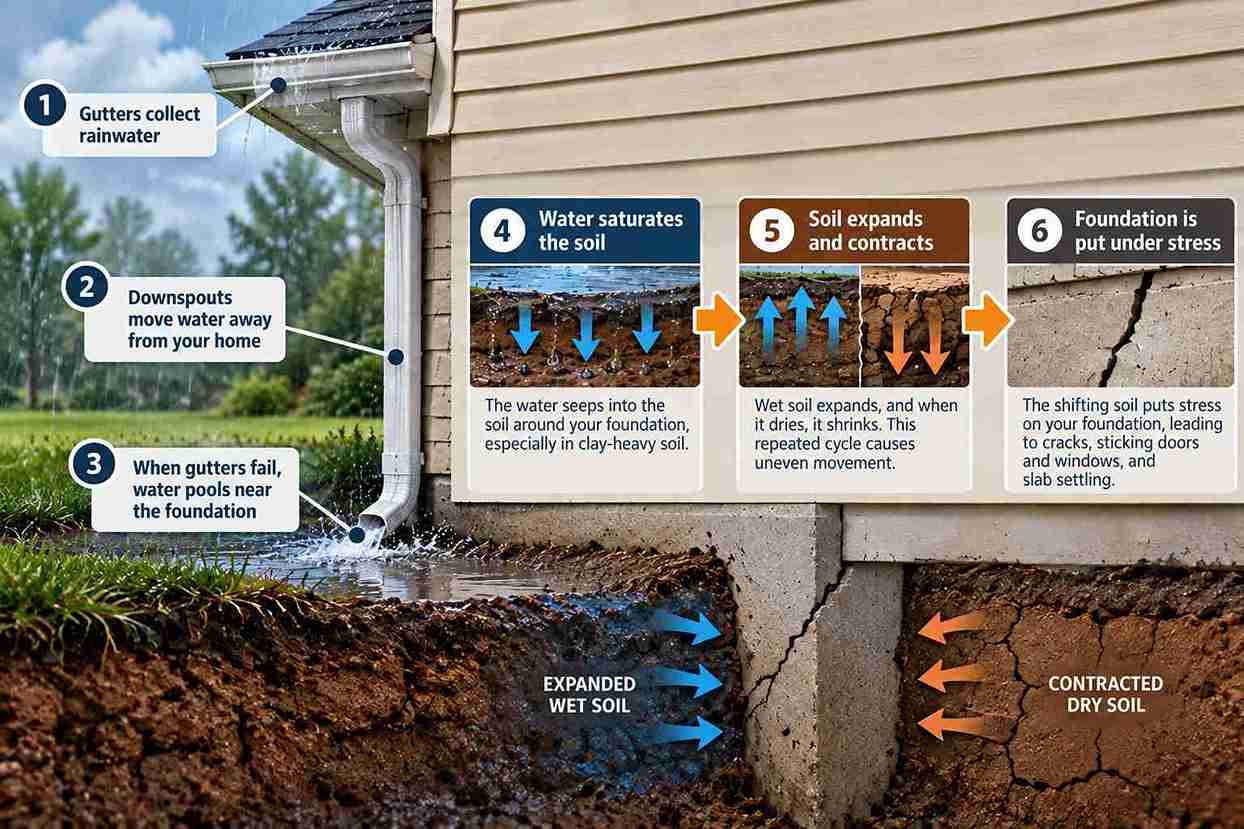
A functioning gutter system does one job above all else: it moves water away from your home’s perimeter. When that system breaks down, whether from clogging, overflow, poor slope, or a missing extension, water ends up pooling right at the base of your walls instead of being carried out into the yard.
That water doesn’t just sit there. It seeps into the soil beneath and around your foundation. In expansive clay soil, this causes the ground to swell unevenly. Some sections of the foundation get pushed up while others stay put, or the soil beneath dries and shrinks unevenly once the water recedes. Either way, the foundation is put under stress it wasn’t designed for.
Over months and years of repeated wet-dry cycles, this uneven movement is what causes cracks, doors and windows that stop closing properly, and slab settling.
Warning Signs Your Gutters Are Putting Your Foundation at Risk
- Visible cracks in the foundation wall or slab, especially ones that are wider at one end than the other
- Standing water or muddy soil near the base of the house after rain, rather than water draining away
- Soil pulling away from the foundation in dry spells, then pressing back tightly after rain.
- Interior cracks in drywall, especially near windows and door frames
- Doors or windows that stick or won’t latch the way they used to
- Uneven or sloping floors in one part of the house
Seeing one of these on its own isn’t necessarily an emergency. Seeing several together, especially near a spot where you already know your gutters overflow or drain poorly, is a strong sign the two problems are connected.
What’s Actually Causing the Water Problem
A few gutter issues are responsible for the vast majority of foundation-related water damage:
Overflow During Heavy Rain
When gutters can’t handle the volume of water coming off the roof, it spills over the front edge and lands in a concentrated line right along your foundation instead of being carried to the downspout.
Missing or Short Downspout Extensions
Even a gutter system that’s working perfectly can still dump water within a foot or two of the foundation if there’s no extension or splash block moving it further out.
Wrong Gutter Slope
Gutters need a slight pitch toward the downspout to drain properly. If the slope is off, water sits in the trough, overflows in the wrong spots, or drains too slowly during a storm.
Clogged Gutters and Downspouts
Leaves and debris block the flow of water, forcing it over the sides of the gutter instead of down through the downspout and away from the house.
Improper Grading Around the Foundation
This isn’t a gutter problem on its own, but it compounds every issue above. If the ground slopes toward the house instead of away from it, even water that makes it past the downspout can flow back toward the foundation.
How to Prevent Foundation Damage From Gutter Issues
Add or Extend Downspout Extensions
Water should be released at least 4 to 6 feet away from the foundation, further if your yard is flat or slopes toward the house.
Check and Correct Gutter Slope
A gutter that isn’t pitched correctly needs to be reset, not just cleaned. This is a job for a professional if the sagging or misalignment is widespread.
Clean Gutters on a Regular Schedule
In a region with heavy tree cover, twice a year is usually the minimum. Gutter guards can reduce how often this needs to happen but don’t eliminate the need.
Fix Overflow Issues at the Source
If your gutters overflow every time it rains hard, extending the downspout further out treats the symptom, but the overflow itself needs to be addressed too, since it’s often a sizing or clog issue rather than something a splash block alone can fix.
Regrade Problem Areas
If soil near your foundation slopes toward the house, adding fill dirt to redirect the slope away from the walls makes a real difference, even with gutters working properly.
Watch for Standing Water After Every Major Rain
A quick walk around the house after a storm tells you more than any inspection months later. If water’s pooling somewhere, that’s the exact spot to fix first.
Prevention Costs Far Less Than the Repair
Extending a downspout or regrading a section of yard costs a fraction of what foundation repair runs. Foundation repair in Texas can range from a few thousand dollars for minor crack injection to well into five figures for pier and beam work on a settling slab. Gutter maintenance and correction, by comparison, is one of the cheapest ways to protect a home’s structure long-term.
FAQs
Can gutters really cause foundation cracks?
Yes. Water that isn’t carried away from the foundation saturates the soil beneath and around it, causing the expansion and contraction that leads to cracking, especially in clay-heavy soil like much of the Texas Hill Country.
How far should downspouts drain from the house?
At least 4 to 6 feet, and further if the yard is flat or slopes back toward the foundation.
What’s the first sign gutters are affecting my foundation?
Standing water or soft, muddy soil at the base of the house right after rain is usually the earliest and clearest sign, often showing up before any visible cracking does.
Is foundation damage from gutters covered by insurance?
Typically not. Most homeowners’ policies treat this as a maintenance issue rather than a sudden, covered event, which is part of why prevention matters so much.
Protect Your Foundation Before It Cracks
Gutters and foundations don’t seem connected until you’re standing in front of a crack that could’ve been prevented with a downspout extension. Overflowing gutters are one of the biggest contributors to water pooling near your foundation. See why gutters overflow in heavy rain for the full breakdown of what causes it and how to fix it.
If you’re noticing pooling water, cracks, or gutters that just don’t seem to keep up during storms, it’s worth having your system checked before the soil around your home has a chance to do any real damage.
Protect Your Home With Professional Gutter Solutions
Don’t wait for a small drainage problem to turn into costly foundation damage. American Hill Country Gutters provides professional gutter installation, repair, and leaf protection solutions designed to keep rainwater flowing away from your home’s foundation.